
How to Choose the Right Tutor for Your Child: A Complete Parent's Guide
13/09/2026
How to Choose the Right Tutor for Your Child:
A Complete Parent's Guide
Introduction
Hiring the wrong tutor wastes money, time, and worse your child's confidence. Hiring the right one can turn a struggling subject into a strength within weeks. The difference usually isn't luck; it's process.
Whether you're searching for home tutors who can work with your child in person, or a lesson teacher who can deliver structured sessions online, the same core question applies: how do you actually evaluate a stranger's ability to teach your specific child, in your specific subject, under your specific constraints?
This guide walks through a practical, step-by-step framework for choosing the right tutor — covering credentials, teaching style, personality fit, logistics, and red flags to avoid. When you're ready to start browsing vetted options, you can search verified home tutors and lesson teachers at Find a Teacher.
Step 1: Define What You Actually Need
Before evaluating any tutor, get specific about the problem you're solving. "My child needs help in math" is too vague to act on.
Ask yourself:
Is this about catching up on missed fundamentals, or getting ahead of the curriculum?
Is there a specific exam or deadline (WAEC, JAMB, SAT, IGCSE, a school test)?
Does my child need help with the subject itself, or with study habits and confidence?
Would my child do better with a home tutor who provides in-person structure, or a lesson teacher delivering focused online sessions?
Writing this down before you search prevents you from hiring based on price or availability alone.
Step 2: Verify Credentials and Subject Expertise
A tutor's qualifications should match the actual work required — not just a general teaching background.
What to check:
Relevant subject qualification or degree (a physics graduate for physics, not a general "all-subjects" tutor)
Experience teaching the specific curriculum or exam board your child follows
Track record with students of a similar age or academic level
For online sessions, comfortable with using lesson teacher platform's tools (whiteboards, screen sharing, recorded lessons)
The most important credential for a tutor is documented, relevant experience with the exact subject, age group, and curriculum your child needs — not just a general teaching qualification.
Step 3: Prioritize Background Checks and Safety
This step is non-negotiable, especially for home tutors who will be alone with your child in your house.
Confirm identity verification and background screening, particularly for in-home visits
Ask for at least one reference from a family member.
Check reviews on the platform or agency the tutor is listed with
For online lesson teachers, confirm the platform records sessions or provides some form of session oversight
Platforms that formally vet tutors before listing them — such as Find a Teacher — remove much of this manual verification burden from parents.
Step 4: Evaluate Teaching Style, Not Just Knowledge
Knowing a subject and teaching it well are different skills. A brilliant engineer can be a poor tutor if they can't break concepts down for a struggling 12-year-old.
Signs of a strong teaching style:
Asks questions to check understanding rather than just lecturing
Adapts explanations when the first approach doesn't land
Uses real examples relevant to your child's interests
Gives your child room to attempt problems independently before jumping in
Signs of a weak fit:
Sticks rigidly to one explanation method
Talks more than the student does during sessions
Can't explain why a topic matters or connect it to real use
Step 5: Test Personality and Rapport Fit
Even a highly qualified tutor can fail if your child doesn't feel comfortable with them. Personality fit affects whether your child actually engages during lessons or quietly disengages.
How to assess fit:
Book a trial lesson before committing to a long-term package
Ask your child directly how the session felt — rushed, boring, clear, encouraging?
Watch for whether the tutor is patient with mistakes or subtly makes the child feel slow
For younger children, sit in on part of the first session (for home tutors) or the first online call (for a lesson teacher)
Step 6: Compare Logistics — Format, Schedule, and Cost
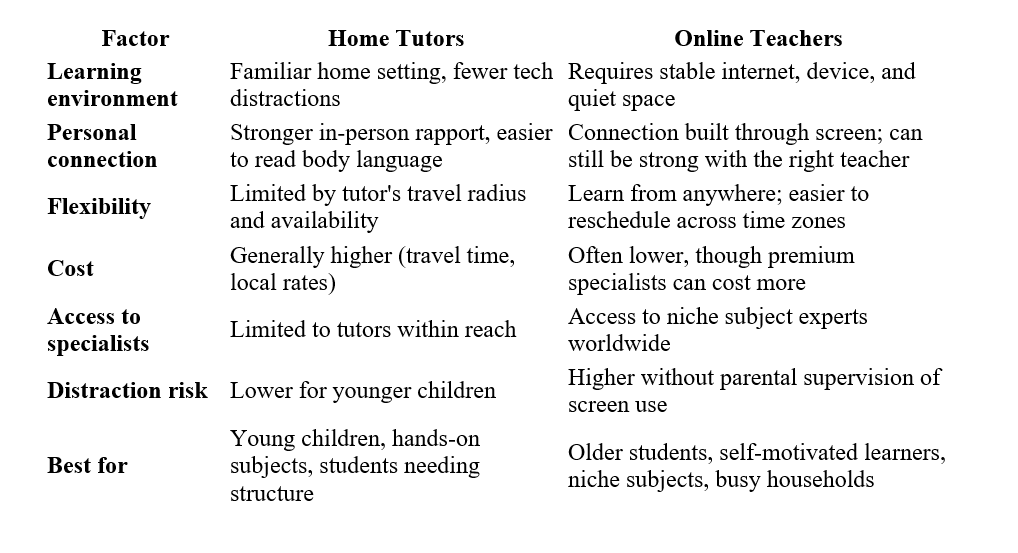
Choose the format that fits your actual weekly routine — not the one that sounds best in theory. A perfect tutor you can never schedule is not a good tutor for your family.
Step 7: Set Clear Expectations From the Start
Once you've chosen a tutor, put expectations in writing before the first paid session:
Session length, frequency, and cancellation policy
How progress will be communicated (weekly updates, report cards, informal chats)
Homework or practice expectations between sessions
A review point — for example, reassessing fit after 4–6 sessions
This protects both you and the tutor and gives you a natural checkpoint to switch if things aren't working.
Red Flags to Watch For
Reluctance to provide references or proof of qualifications
No willingness to do a trial lesson
Vague answers about their teaching approach
Pressure to commit to long, non-refundable packages upfront
Inconsistent communication before you've even started
If you notice two or more of these during the hiring process, keep looking.
E-E-A-T: Why the Hiring Process Matters More Than the Search
EEAT means Experience, Expertise, Authoritativeness, and Trustworthiness.
Parents often focus energy on finding tutors and rush the evaluating stage. In reality, a structured evaluation process - checking credentials, verifying safety, testing fit through a trial lesson is what actually predicts whether a tutoring relationship works. Experience shows that trial sessions surface personality and teaching-style mismatches far more reliably than a resume or a phone call ever will.
Find Vetted Home Tutors and Lesson Teachers
Rather than manually verifying every credential and background check yourself, Find a Teacher pre-vets home tutors and online lesson teachers, so you can compare profiles, read reviews, and book a trial lesson with confidence — cutting weeks off the hiring process.
Frequently Asked Questions
What qualifications should I look for in a tutor?
Look for a qualification or degree relevant to the specific subject your child needs help with, plus documented experience teaching students of a similar age and curriculum — not just a general teaching background.
Should I choose a home tutor or an online lesson teacher?
Choose a home tutor for young children, hands-on subjects, or students who need in-person structure. Choose an online lesson teacher for specialist subjects, flexible scheduling, or when the right expert isn't available locally.
How many trial lessons should I book before committing?
One trial lesson is usually enough to assess teaching style and personality fit. If the first session raises concerns, a second trial with a different tutor is more useful than continuing with a poor match.
What's a reasonable price for a home tutor or lesson teacher?
Pricing varies by subject, location, and tutor experience. Home tutors typically charge more due to travel time, while online lesson teachers often have lower rates. Compare multiple profiles on the same platform to gauge a fair local range.
How do I know if a tutor is safe to hire for in-home lessons?
Confirm the tutor has undergone identity verification and background screening, ask for references from recent families, and check reviews on the platform they're listed with before allowing in-home sessions.
What should I do if the tutor isn't working out?
Set a review checkpoint (for example, after 4–6 sessions) when you hire a tutor. If progress or rapport isn't there by that point, it's reasonable to end the arrangement and try a different tutor rather than persisting out of obligation.
Key Takeaways
Define the specific problem before searching — vague goals lead to poor tutor matches.
Verify credentials, background checks, and references before any in-home or online sessions begin.
Teaching style and personality fit matter as much as subject knowledge — test both with a trial lesson.
Match the format (home tutor vs. lesson teacher) to your real schedule, not an idealized one.
Set clear expectations and a review checkpoint from day one.
Ready to start?
Compare vetted home tutors and lesson teachers on Find a Teacher.