Home Tutors vs. Online Tutors: Which Is Better for Your Child in 2026
12/09/2026
Home Tutors vs. Online Tutors:
Which Is Better for Your Child in 2026
Introduction
Every parent eventually asks the same question: should my child learn with a home tutor who comes to the house, or an online teacher who joins from a screen? Both formats can raise grades, rebuild confidence, and close learning gaps — but they do it in very different ways.
The honest answer is: neither format is universally "better." The right choice depends on your child's learning style, your schedule, your budget, and the subject in question. This guide compares home tutors and online tutors across the factors that actually matter — cost, convenience, accountability, technology access, and long-term results — so you can make a confident decision instead of a guess.
If you decide a home tutor is the right fit, you can browse and book vetted, background-checked tutors near you at Find a Teacher.
What Is a Home Tutor?
A home tutor is a private instructor who travels to a student's home (or another agreed physical location, like a library) to deliver one-on-one or small-group lessons. Home tutoring is one of the oldest forms of personalized education, predating formal schooling itself, and remains popular for subjects like mathematics, sciences, languages, and exam preparation.
Key characteristics of home tutors:
In-person, face-to-face instruction
Lessons typically held at the student's home
Physical materials (books, worksheets, whiteboards) used directly
Strong rapport-building through in-person presence
Often hired through referrals or dedicated tutoring platforms
What Is an Online Teacher?
An online teacher delivers instruction remotely through video conferencing tools, learning management systems, and digital whiteboards. Online teaching surged during the pandemic and has remained a mainstream option because of its flexibility and reach.
Key characteristics of online teachers:
Instruction delivered via video call or learning platform
Access to teachers regardless of geographic location
Digital resources: shared screens, recorded sessions, interactive apps
Flexible scheduling across time zones
Often lower overhead costs, which can affect pricing
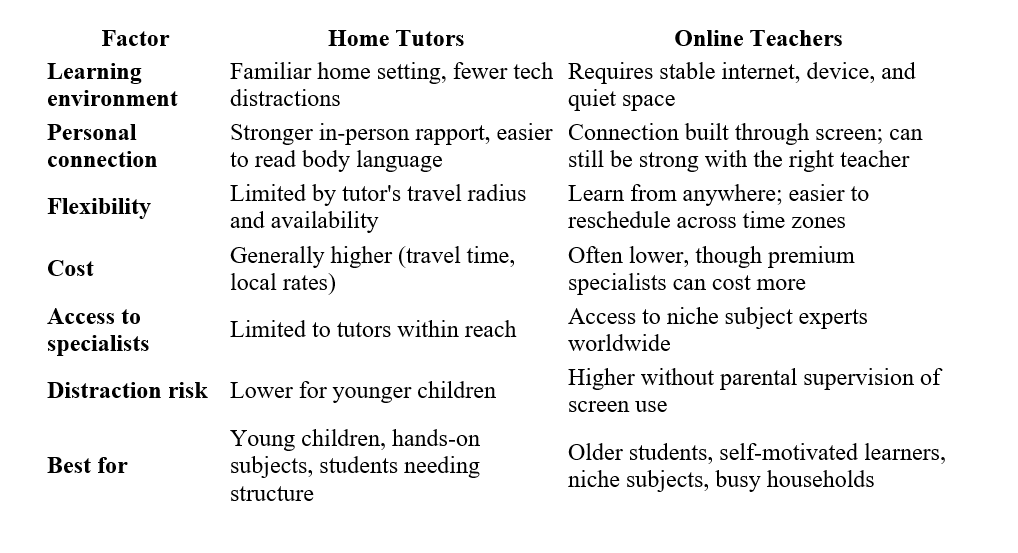
Home Tutors vs. Online Teachers: Side-by-Side Comparison
Home Tutors: Advantages and Drawbacks
Advantages of Home Tutors
Personalized, distraction-free attention — With no screen between teacher and student, home tutors can quickly notice confusion, frustration, or disengagement and adjust in real time.
Comfort and familiarity — Learning in a known environment reduces anxiety, particularly for younger children or students who struggle in classroom settings.
Hands-on learning — Subjects like early literacy, handwriting, art, and lab-based sciences often benefit from physical materials and direct demonstration.
Built-in accountability — A tutor physically present in the home tends to reinforce routine and discipline more effectively for some students.
Drawbacks of Home Tutors
Higher cost — Travel time and local market rates usually make home tutoring more expensive per hour than online alternatives.
Limited geographic pool — You're restricted to tutors who can realistically travel to your home.
Scheduling friction — Fitting a commute into a tutor's day limits available time slots.
Online Teachers: Advantages and Drawbacks
Advantages of Online Teachers
Access to specialists — Need an IB Physics tutor, a native French speaker, or a competitive coding instructor? Online teaching removes geography as a barrier.
Flexibility — Sessions can be scheduled early morning, late evening, or across time zones, which suits busy families and older students managing extracurriculars.
Recorded sessions — Many online platforms let students revisit recorded lessons, reinforcing retention.
Often more affordable — Without travel costs, online rates can be lower, especially for group classes.
Drawbacks of Online Teachers
Technology dependency — A poor internet connection or unfamiliar device can derail a lesson.
Reduced supervision — Without a parent nearby, some students disengage or multitask during sessions.
Less physical interaction — Subjects requiring hands-on correction (like handwriting or lab work) are harder to teach remotely.
Which Option Is Better for Specific Situations?
Best for Young Children (Ages 5–12)
Home tutors generally win here. Younger learners benefit from physical presence, hands-on correction, and the structure of an adult in the room minimizing distractions.
Best for Exam Preparation (WAEC, JAMB, SAT, IGCSE)
Both formats work well, but the deciding factor is specialist access. If a top-rated exam coach for your subject isn't available locally, an online teacher may deliver better results than a less-specialized home tutor.
Best for Busy or Traveling Families
Online teachers offer superior flexibility since lessons aren't tied to a commute or fixed location.
Best for Students Who Struggle with Screen Time
If a child is already overexposed to screens, a home tutor provides a healthier, more focused learning environment.
Best for Niche or Advanced Subjects
Online teaching wins when the right expert doesn't live nearby — coding, advanced languages, music theory, and specialized university-entrance coaching are easier to source online.
How to Choose: A Quick Decision Framework
Define the goal — Is this about catching up, getting ahead, or exam readiness? Specialist subjects lean online; foundational skills lean home tutor.
Assess your child's learning style — Distractible or younger learners often do better in person; independent, tech-comfortable students often thrive online.
Set a realistic budget — Compare hourly rates for both formats in your area before deciding.
Test before committing — Book a trial session in either format to see how your child responds before signing up for a long-term plan.
Prioritize vetting and safety — Whichever format you choose, confirm the tutor or teacher has verified credentials, background checks, and references.
E-E-A-T: Why Vetting Your Tutor Matters
EEAT- Experience, Expertise, Authoritativeness, and Trustworthiness. Choosing between a home tutor and an online teacher is only half the decision — vetting quality matters just as much as format. Look for:
Verified qualifications in the subject being taught
Background checks, especially for in-home visits
Reviews or references from other parents
A trial lesson before committing to a long-term package
Clear communication about progress, homework, and goals
Find Vetted Home Tutors Near You
If you've weighed the options and a home tutor is the right fit for your family, visit Find a Teacher, and connects parents and students with vetted, background-checked home tutors and online teachers across a wide range of subjects. You can compare tutor profiles, , and book trial sessions before committing — making the home-tutor-vs-online-teacher decision easier and lower-risk.
Frequently Asked Questions
Are home tutors more effective than online teachers?
Neither is universally more effective. Home tutors tend to work better for young children and hands-on subjects, while online teachers often outperform for specialist subjects, exam coaching, and self-motivated older students. Effectiveness depends more on tutor quality and student fit than on format alone.
Are home tutors more expensive than online teachers?
Generally, yes. Home tutors typically charge more per hour to account for travel time and local market rates, while online teachers often have lower overhead and can offer more competitive pricing, especially for group sessions.
Can a home tutor and online teacher be used together?
Yes. Many families use a hybrid approach — a home tutor for foundational subjects or younger children, and an online teacher for specialized subjects or exam prep where local expertise is limited.
How do I find a safe, vetted home tutor?
Look for tutoring platforms that perform background checks and verify credentials, request references from other parents, and always start with a trial lesson before committing to a long-term arrangement. Find a Teacher vets tutors before listing them.
Is online tutoring as effective as in-person tutoring for young children?
Online tutoring can work for young children but generally requires closer parental supervision to maintain focus, since younger students are more easily distracted by screens and less able to self-manage a virtual learning environment than older students.
What subjects work best with home tutors?
Early literacy, handwriting, mathematics fundamentals, laboratory sciences, and any subject requiring hands-on demonstration or close physical supervision tend to work best with home tutors.
Key Takeaways
Home tutors excel with young children, hands-on subjects, and students who need structure and minimal distraction.
Online teachers excel with specialist subjects, flexible scheduling, and self-motivated older students.
Cost, access to specialists, and your child's learning style should drive the decision more than personal preference alone.
Vetting matters more than format — a poorly matched tutor in either setting will underperform a well-matched one.
Ready to compare options?
Browse vetted home tutors and online teachers on Find a Teacher.