
Benefits of One-on-One Home Tutoring: Why Personalized Learning Gets Better Results
13/09/2026
Introduction: The Case for Personalized Learning at Home
Every child learns differently — some need extra time with fractions, others race ahead in reading but freeze up during exams, and many simply need someone patient enough to explain a concept three different ways until it clicks. In a classroom of dozens of students, even the best teacher can't give every child that kind of individual attention.
That's the gap home tutoring fills. Rather than asking a child to keep pace with an entire class, one-on-one tutoring reshapes the lesson around the child. For parents comparing tutoring options, understanding exactly what that shift makes possible — academically, emotionally, and logistically — is the first step to deciding if it's right for your family.
What Is One-on-One Home Tutoring?
One-on-one home tutoring is a personalized learning arrangement where a single student works directly with a dedicated tutor, usually in the student's own home, with lessons built entirely around that student's pace, learning style, and academic needs. Unlike group tutoring or classroom instruction, there is no need to move on before a concept is fully understood, or to slow down once a student is ready to advance.
Top Benefits of One-on-One Home Tutoring
1. Fully Personalized Pace and Teaching Style
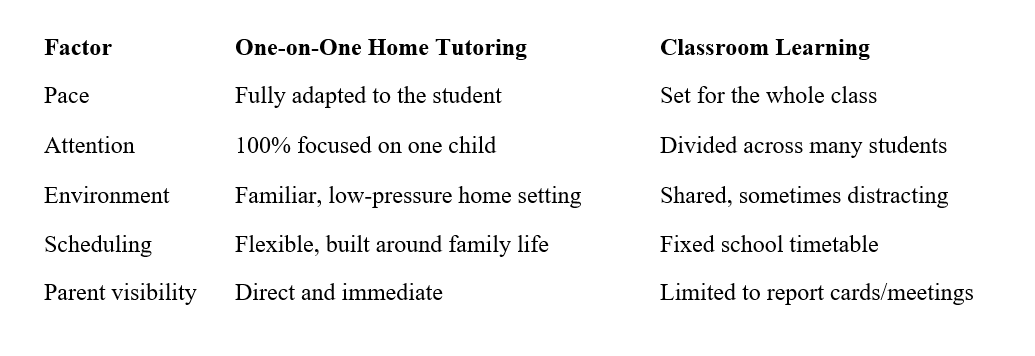
A home tutor isn't managing a curriculum for 30 students — they're managing one. That means lessons can move as fast or as slowly as the child needs, and a tutor can shift explanations, examples, and even teaching style (visual, verbal, hands-on) until something resonates. This kind of responsiveness is nearly impossible to replicate in a traditional classroom.
2. Faster Identification and Closing of Learning Gaps
Because a tutor is focused on one student, small misunderstandings surface immediately instead of compounding silently for weeks. A tutor can catch a shaky grasp of multiplication before it undermines algebra, or notice a reading comprehension gap before it affects every other subject.
3. Stronger Academic Confidence
Struggling in front of classmates can make children reluctant to ask questions or admit confusion. In a private, one-on-one setting, there's no social pressure — a child can ask the "obvious" question, get something wrong, and try again without an audience. Over time, this safety net tends to translate into a more confident learner even outside tutoring sessions.
4. Comfort and Familiarity of a Home Environment
Learning in a familiar setting — the child's own home — removes the stress of a new environment or an unfamiliar commute. This is especially valuable for younger children, children with anxiety around new places, or families juggling tight after-school schedules.
5. Direct Parent Involvement and Visibility
With home tutoring, parents can see progress firsthand — sitting in on a session, reviewing what was covered, or simply talking to the tutor directly after each lesson. This kind of transparency is harder to get from a school teacher managing a full classroom, or from a tutoring center where sessions happen off-site.
6. Flexible Scheduling Around Your Family's Life
Home tutors typically work around a family's actual schedule rather than the other way around — evenings, weekends, exam-crunch weeks, or a lighter routine during school holidays. That flexibility matters for busy households juggling multiple children, activities, and work schedules.
7. Targeted Exam and Skill Preparation
Whether it's a specific exam, a subject a child is falling behind in, or a skill they want to get ahead on, one-on-one tutoring can be built entirely around that goal — without needing to also cover material the child has already mastered.
Home Tutoring vs. Classroom Learning — A Quick Comparison
Who Benefits Most From Home Tutoring?
Students who are falling behind and need to close specific gaps
High-achieving students who need to move faster than their classroom pace allows
Children preparing for exams or entrance tests
Students who feel anxious or shy about asking questions in class
Families who want more direct visibility into their child's academic progress
Frequently Asked Questions About Home Tutoring
Is one-on-one tutoring more effective than group tutoring? For most students, yes — because lessons are built entirely around a single learner's pace and needs rather than balanced across multiple students with different levels.
How do I find a qualified home tutor? Look for a vetted, background-checked tutor with subject-matter expertise and experience teaching your child's age group. Platforms like Find a Teacher connect parents directly with verified home tutors and online teachers, making it easier to find the right match without guesswork.
Is home tutoring only for struggling students? No. Home tutoring benefits students at every level — from those needing extra support to those looking to move ahead of their current curriculum.
How often should a child have home tutoring sessions? This depends on the child's goals, but many families start with one to three sessions a week and adjust based on progress and upcoming academic milestones.
Find the Right Home Tutor for Your Child
One-on-one home tutoring works because it puts your child's specific needs — not a classroom average — at the center of every lesson. If you're ready to find a vetted, background-checked tutor who fits your child's schedule and learning style, explore verified home tutors and online teachers at Find a Teacher.
Other Similar Articles
Semantic keywords covered: home tutoring, one-on-one tutoring, private tutor, personalized learning, home tutors, tutor for your child, online teachers, find a teacher, exam preparation tutoring, academic confidence.